SACRAMENTO, CA — Steve Fleming, president and chief executive officer of River City Bank (the Bank), announced that the Bank’s board of directors has approved, in connection with the Bank’s recently reported net income of $6.1 million or $4.20 diluted earnings per share for the quarter ending June 30, 2020, a cash dividend of $0.30 per common share to shareholders of record as of August 4, 2020, and payable on August 18, 2020.
River City Bank reports net income of $6.1 million for the second quarter and $13.4 million year to date
SACRAMENTO, CA — River City Bank (the Bank) reported net income of $6.1 million, or $4.20 per diluted share, for the quarter ending June 30, 2020, which compares to the $6.5 million, or $4.44 per diluted share, for the same period in 2019. Net income was $13.4 million or $9.16 per diluted share for the six months ending June 30, 2020, which compares to the $12.4 million or $8.51 per diluted share for the six months ending June 30, 2019.
The improved net income for the six months versus the prior year period was driven by a $7 million or 23% increase to net interest income from higher loan balances. Average loan outstandings, including Paycheck Protection Program (PPP) loans were $461 million higher than the prior year period, thereby increasing loan interest and fee income. PPP loans originated in the second quarter totaled $283 million as of June 30, 2020. Partially, offsetting the higher level of loan interest and fee income were the following:
- Provision for loan losses of $5.5 million or $3.5 million higher than the prior year period. Approximately $4.3 million of this provision can be attributed to the exceptional loan growth (over $200 million, excluding the PPP loans which are guaranteed by the US Government’s Small Business Administration), with the remaining $1.2 million primarily due to some Covid-19 caused deterioration in loan quality.
- Mark to market on the interest rate swaps resulting in a loss of $1.5 million for the six months ending June 30, 2020 compared to zero for the prior year period. The Bank entered into these swap agreements to hedge the interest rate risk associated with its ongoing origination of medium-term fixed rate loans. Because certain of the Bank’s interest rate swaps were not designed to receive hedge accounting treatment, these swaps must be carried on the balance sheet at fair market value with any changes in value recorded in the income statement.
“Until an effective vaccine is developed and widely distributed amongst the population, we believe that the California economy will be seriously stressed; we are very pleased to be entering this period with solid asset quality metrics”, said Steve Fleming, president and chief executive officer of River City Bank. “Through our disciplined and financially conservative loan underwriting and diligent management of the portfolio, we have reported no non-performing loans over the past three consecutive quarters. Perhaps even more importantly is the minimal number of loan modifications that we have had to make as a result of the COVID-19 pandemic.” The COVID-19 related loan modifications through June 30, 2020 consisted of the following:
- Consumer: One residential mortgage loan with an outstanding balance of only $6,278 had its P&I payments deferred to October 2020.
- C&I: One loan with an outstanding balance of $1.3 million had its P&I payments deferred to July 15, 2020.
- CRE: Seven loans with an aggregate outstanding balance of $24 million have been making interest only payments for three months.
“In addition to the exceptional loan growth noted above, we also experienced outstanding deposit growth of $542 million or 25% during the first half of 2020”, said Steve Fleming. “It should be noted that some of this deposit growth is temporary in nature due to an extension in the tax filing due date from April 15 to July 15 and the recent funding of the PPP loans into deposit accounts at the Bank. Nevertheless, we are very pleased with the trust placed in us by our deposit customers, which has allowed us to continue our robust lending into the communities we serve. Though our branches remain open to provide services to our customers, given the health risks associated with COVID-19, we are continuing to protect our staff through minimizing the number of customers that can enter a branch at one time and are following California’s guidelines for wearing masks and social distancing.”
“Operational efficiency remains a core competency for the Bank, as evidenced by our 36 percent efficiency ratio for the six months ending June 30, 2020” said Anker Christensen, chief financial officer of River City Bank. “Though our total non-interest expense has increased over the prior year period, our focus on managing expenses continues to be evident by our continued low efficiency ratio.”
Shareholders’ equity for River City Bank on June 30, 2020, increased $16.5 million to $253 million, when compared to the $237 million as of December 31, 2019. The increase was driven by current year retained earnings and a $3.5 million increase in accumulated other comprehensive income as the decline in short and medium term interest rates resulted in increased unrealized gains in our Investment securities portfolio. The Bank’s capital ratio remains well above the regulatory definition for being Well Capitalized with a Tier 1 Leverage Ratio of 8.7% as of June 30, 2020.
River City Bank reports an increase to the quarterly cash dividend on common shares
SACRAMENTO, CA — Steve Fleming, President and CEO of River City Bank (the Bank), announced that the Bank’s board of directors has approved, in connection with the Bank’s recently reported net income of $7.3 million, or $4.96 diluted earnings per share, for the quarter ending March 31, 2020, a cash dividend of $0.30 per common share to shareholders of record as of May 5, 2020, and payable on May 19, 2020.
River City Bank reports 2020 first quarter net income of $7.3 million
SACRAMENTO, CA — River City Bank (the Bank) reported net income of $7.3 million, or $4.96 per diluted share, for the quarter ending March 31, 2020, which compares favorably to the $5.9 million, or $4.07 per diluted share, for the same period in 2019. The improved net income versus the prior year quarter was driven by:
- Higher loan balances – Average loan outstandings were $333 million higher than the prior year quarter, thereby increasing net interest income.
- Non-core income of $657,000 during the current quarter related to prepayment penalty and deferred loan fee income on loans that paid off prior to their maturity compared to only $3,000 in the prior year quarter.
- Increased loan income of $428,000 associated with hedge accounting entries related to our interest rate swap contracts compared to only $26,000 in the prior year quarter.
- Partially offsetting the benefits to net income was a $500,000 increase in the provision for loan losses versus the prior year.
“We experienced exceptional deposit growth of $133 million, or 6.2 percent, during the first quarter of 2020,” said Steve Fleming, President and CEO of River City Bank. “We are very pleased with the trust placed in us by our deposit customers, which has allowed us to continue our robust lending into the communities we serve. These are unprecedented times and we are thankful that we can play a vital role through providing Paycheck Protection Program Loans (PPP Loans) to our existing customers as well as some new customers. As of April 20, 2020, we have funded $251 million of these PPP Loans. Our staff has performed at an exceptionally high level to ensure our customers received the resources they needed for their businesses in a timely fashion. Additionally, given the health risks associated with Covid-19, we are protecting our staff through minimizing the number of customers that can enter a branch at one time and through the use of acrylic barriers on our teller-line. Lastly, for those working in our corporate and back offices, we have been able to allow 80-90 percent of those staff to work from home.”
“These will be trying times for our economy and we are very pleased to be entering this period with solid asset quality metrics,” Fleming said. “Through our disciplined underwriting and consistency of monitoring the portfolio, we reported no non-performing loans for the two consecutive quarters ending March 31, 2020, and December 31, 2019.”
After excluding the prepayment penalty, accelerated deferred loan fee income and hedge accounting entries noted above, the Bank’s net interest margin decreased slightly from 2.66 percent to 2.64 percent for the quarters ending March 31, 2019 and 2020, respectively.
“Operational efficiency remains a core competency for the Bank, as evidenced by our 39 percent efficiency ratio for the quarter ending March 31, 2020,” said Anker Christensen, Chief Financial Officer of River City Bank. “Though our total non-interest expense has increased over the prior year quarter, our focus on managing expenses continues to be evident by our continued low efficiency ratio.”
Shareholders’ equity for River City Bank on March 31, 2020, increased $10.4 million to $247 million, when compared to the $237 million as of December 31, 2019. The increase was driven by increased retained earnings and a $3.2 million increase in accumulated other comprehensive income as the decline in short- and medium-term interest rates resulted in increased unrealized gains in our investment securities portfolio. The Bank’s capital ratio remains well above the regulatory definitions for being Well Capitalized, with a Tier 1 Leverage ratio of 9.5 percent as of March 31, 2020.
Kelly Foundation assists local food banks with $220,000 in total grant awards
Individual grant awards presented to five food banks including Sacramento Food Bank and Meals on Wheels of Alameda County
SACRAMENTO, CA – In response to the global coronavirus crisis, the Kelly Foundation awarded a total of five individual grants to Northern California food banks in Sacramento, Yolo, Alameda and Sonoma counties. The grant monies, representing $220,000 in total donations, will be used to secure and refrigerate food supplies, support community deliveries, and pay workers. Recipient organizations include Sacramento Food Bank & Family Services, Yolo Food Bank, Redwood Empire Food Bank, Alameda County Community Food Bank and Meals on Wheels of Alameda County, the latter of which serves food primarily to housebound elders who are among those at greatest risk from COVID-19.
“Access to food is a fundamental right, and the Kelly Foundation is pleased to support families throughout Northern California by awarding grants to five regional food banks serving some of the most at-risk populations,” said Shawn Kelly Devlin, President of the Kelly Foundation and Chairman of the Board of River City Bank. “As demand for these essential services continues to surge, it is imperative that we equip our food banks to meet needs and help our communities rise to the multitude of challenges presented by COVID-19 without sacrificing health and wellness.”
“COVID-19 has stressed our organization like never before, and we are sincerely grateful for this important funding from the Kelly Foundation,” said Melanie Flood, Director of Development and Communications for Sacramento Food Bank & Family Services. “Demand has skyrocketed, and we are seeing people in need who have never asked for assistance from a food program before. This funding will help us continue to purchase food, invest in supplies and equipment to keep pace with demand, and provide vital services while also planning for the next 60 to 90 days.”
“The Redwood Empire Food Bank normally serves 82,000 people per year, and we are projected to serve twice that number because of the COVID-19 crisis,” said David Goodman, CEO of Redwood Empire Food Bank. “This contribution will help us purchase and refrigerate food, pay our dedicated staff and fuel our trucks to make deliveries across Sonoma County. Ultimately, it will keep food on the table for thousands of people who need it.”
“Human lives literally will be saved because we received critical funding to ensure food access to vulnerable people,” said Joy Cohan, Director of Philanthropic Engagement at Yolo Food Bank. “The Kelly Foundation’s generosity will provide more than 10 days of nourishment for the more than 35,000 people experiencing hunger in Yolo County.”
In evaluating the needs of communities throughout its organizational and geographic footprint, the Kelly Foundation prioritized providers and allocated funds according to the total number of people and families served, as well as the urgency of the need. Sacramento Food Bank and Yolo Food Bank each received a grant in the amount of $75,000; Redwood Empire Food Bank received a $25,000 grant, Alameda Food Bank received $12,500 and Meals on Wheels of Alameda County was awarded a grant of $32,500.
The Kelly Foundation supports health and human services, education, culture, environment and civic improvement through its funding. Each year, the Foundation provides approximately $500,000 in grants to organizations that support the Sacramento and North Bay Area regions. Since merging with the RCB Foundation in 2009, the Kelly Foundation, of which River City Bank remains a major contributor, focuses on giving back to the greater Sacramento region through charitable donations.
For more information about the Kelly Foundation, please visit KellyFoundationSacramento.org.
About the Kelly Foundation
The Kelly Broadcasting Company’s KCRA-TV (Sacramento-Stockton-Modest, CA) went on the air on Sept. 5, 1955, and the owners of the Kelly Broadcasting Company established the Kelly Foundation in December 1988 as a formal vehicle for structuring charitable contributions. The Kelly family sold KCRA-TV in 1999 and have continued the Kelly Foundation ever since. In 2009, the River City Bank Foundation merged with the Kelly Foundation, and some executives of the Bank currently serve on the Foundation’s Board. Jon S. Kelly founded River City Bank and continues to support the Bank. His daughter, Shawn Kelly Devlin, currently serves as President and Chairman of the Board. The Kelly Foundation is an expression of the importance the Kelly family places on being a good neighbor and citizen in regions where they do business. For more information on the Kelly Foundation, please visit KellyFoundationSacramento.org or call (916) 978-4892.
River City Bank Hosts 11th Annual Business Outlook Event
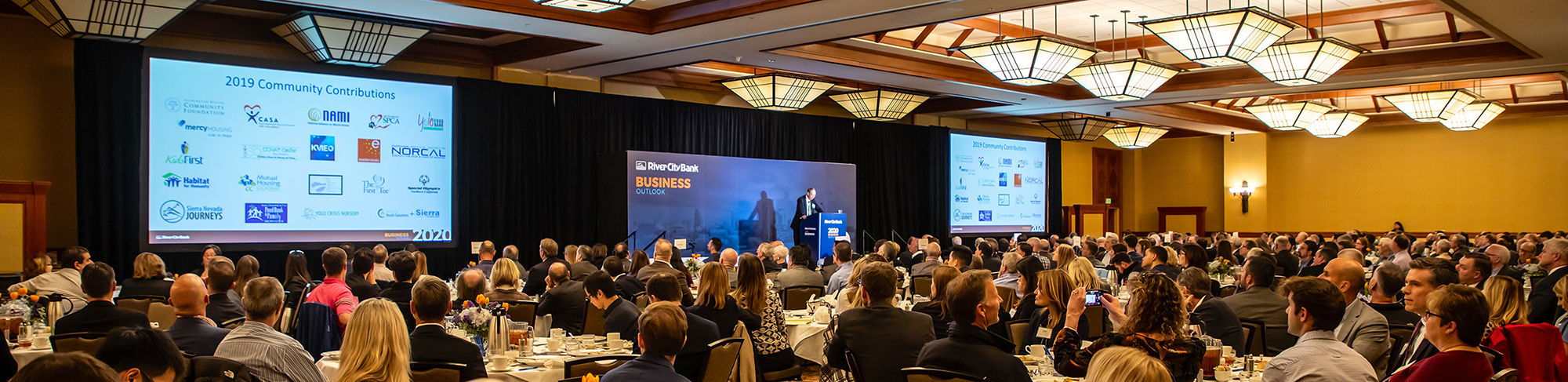
River City Bank’s Business Outlook once again played to a packed house. With a lineup that included Chancellor Gary S. May of the University of California, Davis, and Beth Vaughan, Executive Director of the California Community Choice Association (CalCCA), the audience received a sneak peek into what’s in store for California at both the local and state level. Beth Vaughan spoke on CCAs continued ability to thrive as the demand for renewable energy rapidly grows in California. Chancellor May presented on the collaboration of UC Davis and local businesses to create both educational and economic opportunities in the Sacramento region through the Aggie Square project. RCB President & CEO Steve Fleming spoke on the strength of the Bank and his perspective on the economy.

Steve Fleming, Steve Mills of DCA Capital Partners, and Lon Burford of Genovese Burford & Brothers

Pat McHone of River City Bank with Larry Kelley and Frank Meyers of McClellan Park

Sheri Farinha of Norcal Services for Deaf & Hard of Hearing

Kennard Boutte’-Nears and Linda Bergaus of Life -Assist with River City Bank’s Donna Sutherland

Edmund Knighton of Meristem

Barry Broome of the Greater Sacramento Economic Council
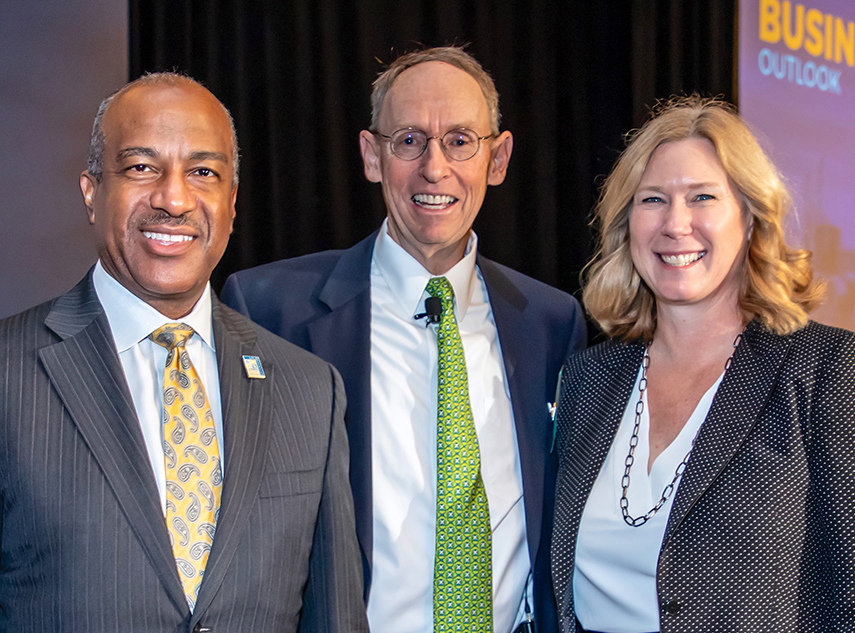
This year’s panel – UC Davis Chancellor Gary S. May, River City Bank’s Steve Fleming, and Beth Vaughan of the California Choice Association

Rick Brown, PhD of Terraverde Energy, Barry Vesser of the Climate Center, and Dan Jennejohn of River City Bank

River City Bank’s Jeremy Spencer with the team from Bender Insurance Solutions: Steve Bender, Heather Rohr, Maggie Bender-Johnson, and Lisa Bracero
Client Profile: Innovative Education Management (IEM)

Founded as Horizon Instructional Systems by Randy Gaschler in 1993, and later renamed Innovative Education Management (IEM) in 1998, IEM successfully develops and operates charter schools throughout the state of California. The company works with the local school districts to gain charter approval and is responsible for every aspect of managing the school. With three charters schools and approximately 6,800 students, currently under its umbrella, IEM’s mission is to ensure that every student has an individualized learning plan, and every parent has the opportunity to make as many decisions as legally possible that directly affect their children’s education.
We caught up with IEM’s CEO, Jodi Jones, to talk more about IEM and the future of charter schools.
What obstacles, if any, were encountered when IEM was first getting off the ground?
In the beginning, cash flow and public misperception due to a lack of knowledge about charter schools were a challenge. While increasingly more parents are choosing charter schools for their children, there are still many myths regarding school choice– and charter schools in particular– that continue to circulate.
What are the differences between charter schools and the traditional brick-and-mortar schools?
Charter schools are tuition-free public schools that are approved by a local school district, county office of education, or the State Board of Education. Charter schools range from pure personalized homeschooling models to traditional brick-and-mortar. Each charter school is unique based on the local community needs. Some charter schools have a specialized curriculum focus, such as performing arts, STEM, Montessori, homeschooling, and individualized hybrid models.
The distinct and unique characteristics of a charter school are described in their charter petition, which is typically submitted to a local school board for approval. IEM is an independent-study charter school, and it specializes in individualized education plans for every student. Our students are generally homeschooled and work closely with a certificated teacher to create a customized learning plan. We serve Pre-K through 12th-grade students throughout California, from Butte County to Riverside County.
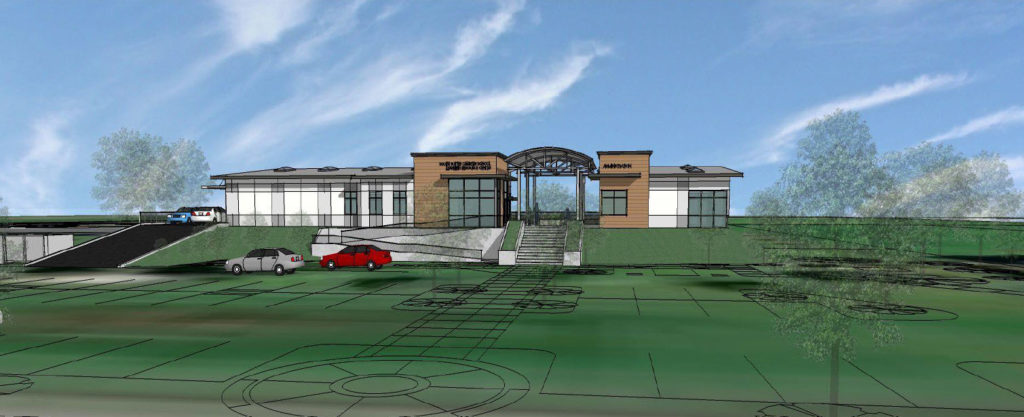
South Sutter Charter Resource Center is slated for completion in July 2020
What percentage of charters schools in California are “independent-study” schools?
Nonclassroom-based charter schools account for approximately 22% of all charter schools in California. That’s around 290 schools of the 1350 charter schools. IEM constitutes roughly 5% of all nonclassroom-based students in California. The beauty of charter schools is that they are born out of a desire of parents, teachers, and community members to develop a school that meets the needs of their students in a way they felt was not offered elsewhere.
“Independent-study” charters like IEM have become havens for families who don’t want their children in traditional brick-and-mortar schools. What are the main reasons for their decision?
One reason could be is that the neighborhood’s public school is too hard, too easy, or just too crowded or impersonal. Along with wanting to control the pace of instruction, parents have become more and more concerned with bullying and safety in traditional schools. They have turned to independent-study charters to help alleviate these worries.
In the case of nonclassroom-based charter schools, parents are always looking for an innovative approach to education. They want flexibility in where and how their children are educated, and they want the ability to seek out experts to provide instructional support rather than relying on a single teacher to provide instruction in all academic subjects. This model of public education has also gained momentum with the rise in concerns about school safety, social issues, and behavioral health needs of students. IEM’s schools provide parents an environment where the academic needs of their children can be addressed without worrying about the social issues they faced in a traditional school. By delivering multiple tools, resources, and programs, IEM helps teachers and parents develop a personalized student success plan that will address their academic and social-emotional needs.
How many states permit charter schools?
As of 2018, all but six states allow charter schools. It is important to note that charter school operations look very different from state to state, based on the charter laws and education code of each location. Currently, under California law, the current cap on charter schools is 2,250 statewide, but the cap is raised by 100 schools each year.
What is currently in the works for IEM?
In Sutter County, a learning resource center is under construction for our South Sutter Charter School. The building will house meeting spaces and rooms for additional activities needed for our students, including science labs. We worked closely with the district to secure vacant land to build the Resource Center. The building is set to be completed by July 2020.
Why did IEM choose River City Bank?
We believe that local small banks provide more personal customer service. River City Bank is no exception.
IEM believes that by combining the concepts of parent decision making and individualized plans, it can help the student truly “experience learning.” To learn more about IEM, visit https://ieminc.org/.
River City Bank reports an increase to the quarterly cash dividend on common shares
SACRAMENTO, CA — Steve Fleming, President and CEO of River City Bank (the Bank), announced that the Bank’s board of directors has approved an increase to the quarterly cash dividends from $0.28 per common share to $0.30 per common share. The increase was made in connection with the Bank’s recently reported net income of $5.8 million and $25.3 million, or $4.00 and $17.33 diluted earnings per share, for the quarter and year ending December 31, 2019, respectively. These quarterly cash dividends will be made to shareholders of record as of February 7, 2020, and payable on February 21, 2020.
River City Bank reports record net income of $25.3 million for 2019
SACRAMENTO, CA — River City Bank (the Bank) reported record net income of $25.3 million, or $17.33 per diluted share, for the year ending December 31, 2019. This was $1.3 million more than the $24.0 million, or $16.50 per diluted share, for the year ending December 31, 2018. The improved net income versus the prior year was driven by:
- Higher loan balances – Average loan outstandings were $208 million higher than the prior year, thereby increasing net interest income.
- Non-core income of $2.0 million and $496,000 for the years ending December 31, 2019 and 2018, respectively — In 2019, the Bank recorded an elevated level of prepayment penalty and deferred loan fee income on loans that paid off prior to their maturity; it also received interest recoveries from loans that were previously charged off.
- Partially offsetting the benefits to net income was a $3.25 million increase in the provision for loan losses versus the prior year. The increased level of provisions for loan losses was attributed to the Bank’s exceptional loan growth.
Additionally, the exceptional loan growth required a higher provision for loan losses in the fourth quarter causing the Bank to report lower net income of $5.8 million or $4.00 per diluted share, for the three months ending December 31, 2019, compared to the $6.8 million or $4.67 per diluted share, for the three months ending December 31, 2018.
Steve Fleming, president and chief executive officer of River City Bank, commented “We are pleased to report our fourth consecutive year of record earnings in 2019, along with exceptional loan (21%) and deposit (24%) growth. We achieved this loan growth due to our excellent reputation in the commercial markets that we operate in throughout California and the decline in long term interest rates. Perhaps more importantly, we accomplished this loan growth without compromising our asset quality. Through our disciplined underwriting and consistency of monitoring the portfolio, we are reporting no non-performing loans as of December 31, 2019.”
The loan growth has also been sufficient to mitigate the negative impact of the rise in the Bank’s cost of funds as it grew deposits at an accelerated pace. After excluding the prepayment penalty and deferred loan fee income noted above, the Bank’s net interest margin declined from 2.70 percent to 2.64 percent for the years ending December 31, 2018 and 2019, respectively.
“Our management team is committed to growing the Bank in an operationally efficient manner as evidenced by maintaining an efficiency ratio under 40 percent for the years ending December 31, 2019 and 2018” said Anker Christensen, chief financial officer of River City Bank. “We have a highly productive group of employees at the Bank and managing expenses continues to be a priority for the management team.”
Shareholders’ equity for River City Bank on December 31, 2019, increased $28 million to $237 million, when compared to the $209 million as of December 31, 2018. The increase was driven largely by increased retained earnings. The Bank’s capital ratios remain well above the regulatory definitions for being Well Capitalized. Common Equity Tier 1, Tier 1 Leverage and Total Risk-based capital ratios were 11.1 percent, 9.5 percent and 12.3 percent, respectively, as of December 31, 2019.
File Your Taxes Before Scammers Do It For You

By Krebs on Security
It’s that time of year, tax-filing season, also known as the season fraudsters start requesting phony tax refunds in the names of identity theft victims. Want to minimize the chances of getting hit by tax refund fraud this year? File your taxes before the bad guys can!
Tax refund fraud affects hundreds of thousands, if not millions, of U.S. citizens annually. Victims usually first learn of the crime after having their returns rejected because scammers beat them to it. Even those who are not required to file a return can be victims of refund fraud, as can those who are not actually due a refund from the IRS. Read the full Krebs on Security article here, and learn more about how fraudsters file phony tax refunds and what you can do to protect yourself.
Should you have any questions about your bank accounts and services, please contact a River City Bank customer service representative at (916) 567-2899.
